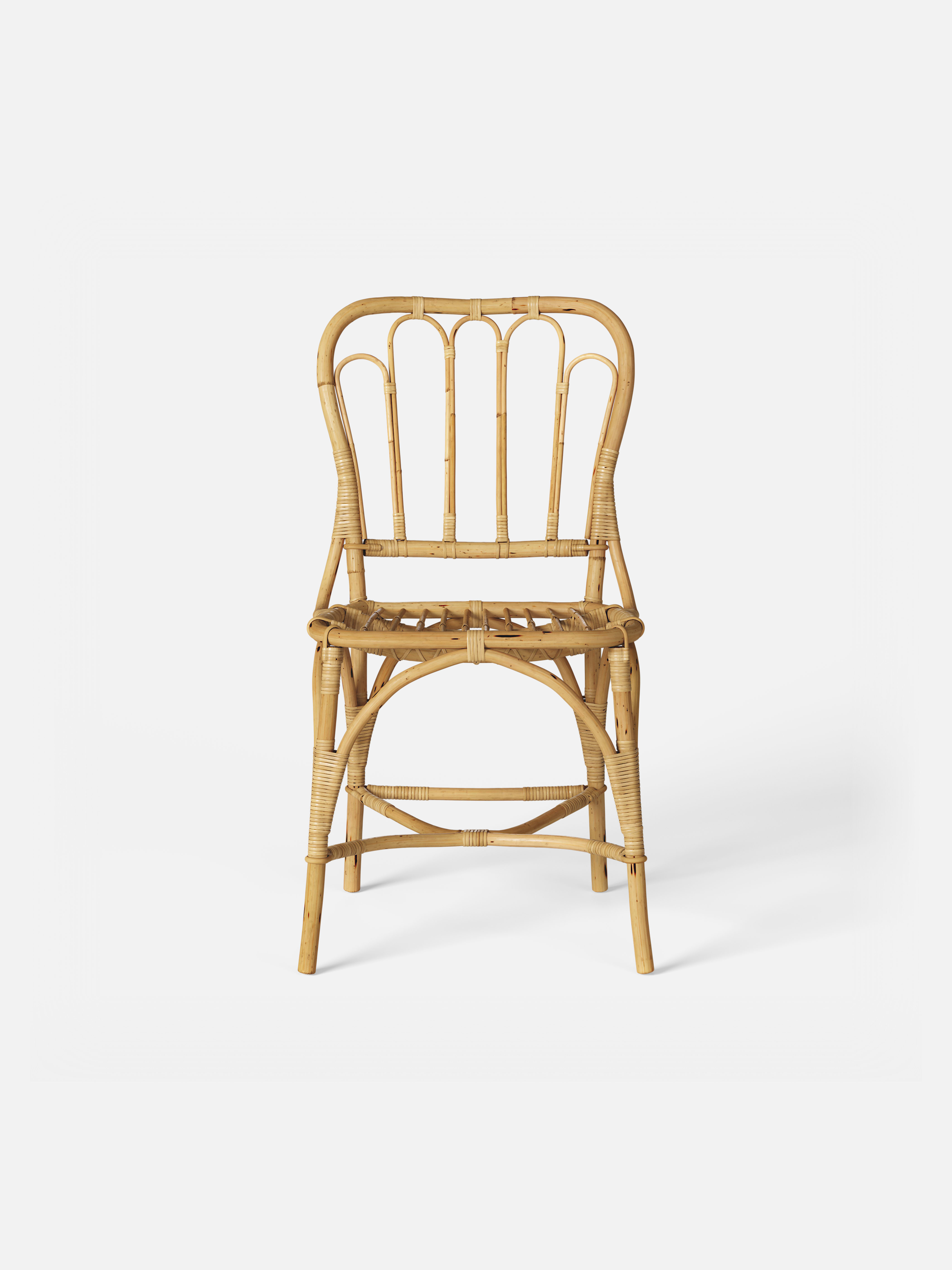
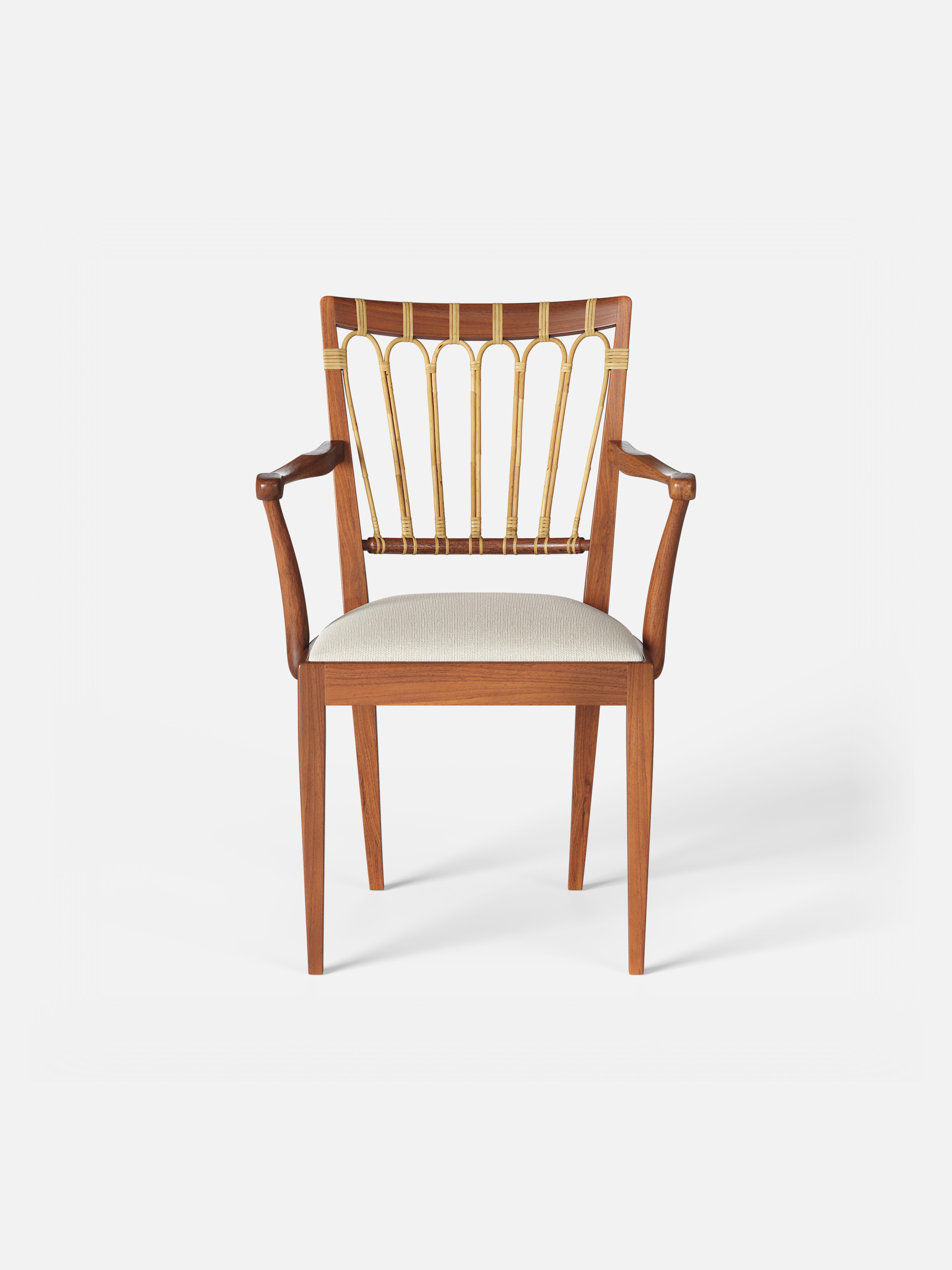
Chair 1165
During his lifetime, Josef Frank designed a large number of chairs and armchairs. Early in his career, he often drew inspiration from historical furniture. For the interior design firm Haus und Garten, which Frank founded together with fellow architect Oskar Wlach, he created chairs that more clearly reflected his own artistic temperament. He later designed several of his most classic chairs for Svenskt Tenn.
Despite the great variety among Josef Frank’s chairs, several fundamental ideas recur throughout their design. According to Frank, a chair should be lightweight and easy to move, while its organic form should contribute to comfort. To avoid creating divisions within a room, for example around a dining table, the back should be transparent. As Frank himself put it: “one should not create architecture with furniture.”
Bringing Josef Frank’s designs to life requires great craftsmanship. At a small number of selected cabinetmaking workshops in Sweden, Frank’s chairs are made by hand, with the utmost care for materials, construction and detail.

A selection of Josef Frank’s chairs.
Ulf Linde, 1982”Every chair here [at Svenskt Tenn] has its own character – and remember what the word character actually means: a sign. Josef Frank’s chairs speak to us; they are a kind of gesture that says: come and sit down!”

Armchair 695, designed by Josef Frank in 1935.


Photo: S. Sundahl
CHAIR 1179
Josef Frank designed Chair 1179 around 1947. The bowl-shaped rattan back, terminating in distinctive “ears”, gives the chair its characteristic expression. Its construction is also unusually complex: the back is a separate element from the rear legs, placing particular demands on the craftsmanship.
Josef Frank often combined different materials in his furniture, and Chair 1179 brings together mahogany, rattan and leather. The seat is made of leather and attached to the side rails with a decorative row of brass tacks, known as pearl nailing.
In keeping with Frank’s ideal of lightweight chairs with transparent backs, Chair 1179 features six rattan spindles. The rattan work is carried out by Larsson Korgmakare in Stockholm. The top rail extends outwards to form the chair’s distinctive “ears” and is shaped from a single continuous piece of rattan, formed freehand – a process requiring considerable craftsmanship.

Chair 1l65, designed 1947.
CHAIR 1165
Josef Frank designed Chair 1165 in 1947. The chair is characterised by its open back in wrapped rattan, mahogany frame and upholstered seat. Its lightweight, organic form reflects several of the qualities that Frank himself considered important in chair design.
Behind its seemingly simple expression lies a complex construction, with carefully worked wooden elements and precise joints. The turned details also add a decorative dimension to the construction. Once the parts have been glued together, the joints are finished by hand to create smooth, even transitions.
ARMCHAIR 966
In Armchair 966, designed in 1938, Josef Frank drew on earlier furniture traditions. The horseshoe-shaped backrest and splayed legs reveal inspiration from ancient klismos and sella chairs. The craftsmanship is evident in the many details: the chair is assembled piece by piece, with several joints concealed in the finished piece.
The armchair can also be seen in Estrid Ericson’s interior at Tolvekarna from 1952, upholstered at the time in a leopard-patterned textile.

Chair 2025, designed by Josef Frank 1925.

Turned wooden details, Chair 2025.